• Skip to main content
  • Skip to primary sidebar

Homemade Circuit Projects

Need circuit help? Post them in the comments! I've answered over 50,000!

Blog | Categories | About | Hire Me | Contact | Calculators-online
You are here: Home / Battery Charger Circuits / Self Regulating Battery Charger Circuit

Self Regulating Battery Charger Circuit

Last Updated on May 17, 2026 by Swagatam 263 Comments

In this post I have explained how a neat little self regulating automatic battery charger circuit can be made using just two inexpensive transistors.

Table of Contents
  • How it Works
  • How to Sep Up the Circuit
    • Parts List
  • Formulas and Calculations

This circuit will automatically regulate the charging supply to the battery depending on its charge level, by switching the input supply ON and OFF periodically.

How it Works

As can be seen in the diagram, this auto-regulating battery charger circuit utilizes just two transistors for detecting the charging thresholds, and cuts off the process as soon as these limits are detected.

Using two transistor actually makes the design hugely sensitive compared to a single transistor charger circuit.

The indicated preset is set in such a way that the T1 is just able to conduct at the specified full charge threshold of the battery.

When this happens T2 begins switching OFF, and ultimately at a point it is unable to sustain the relay conduction and switches OFF the relay, which in turn cuts of the input charging source with the connected battery.

Conversely, when the battery voltage begins dropping, T1 gradually deprived of its adequate conduction voltage level, and ultimately it ceases to conduct, which quickly prompts T2 to initiate its conduction and trigger the relay into action,

The relay now reconnects the charging input supply with the battery, and restores the charging process until it yet again reaches the full charge threshold, when the regulating cycle repeats itself.

How to Sep Up the Circuit

Setting up this battery charger circuit for automatic regulation is very simple and may be done in the following way:

  • Initially, do not connect the fixed transformer power supply; instead connect a 0-24V, variable supply voltage to the circuit.
  • Remove the anode of D6 from the relay contact and connect it to the positive of the power supply.
  • Keep both the presets somewhere at the center position.
  • Switch ON the power and adjust the voltage to 11.5 volts or lower.
  • Adjust P2, so that the relay just activates.
  • Now increase the volts to about 13.5 volts, and adjust P1 so that the relay just deactivates.

The setting procedure of the circuit is now complete.

Check the whole procedure by continuously varying the voltage up and down.

You may now remove the variable power supply and connect the fixed transformer, bridge power supply to it.

DON’T FORGET TO RECONNECT THE ANODE OF D6 BACK TO THE RELAY CONTACT OR THE BATTERY POSITIVE.

The battery connected to this circuit will be charged only as long as its voltage is in between the above "window" level.

If the battery voltage crosses the above "window", the relay will trip and stop the battery from charging.

Parts List

  • R1, R2 = 10K = 2
  • P1, P2 = 10K PRESET = 2
  • T1, T2 = BC 547B = 2
  • C1 = 2200uF/25V = 1
  • C2 = 47uF/25V (Please connect this capacitor across the relay coil) = 1
  • D1---D4 = 1N5408 = 4
  • D5, D6 = 1N4007 = 2
  • RELAY = 12 VOLT, SPDT = 1
  • TRANSFORMER = 1, (AS PER THE CONNECTED BATTERY AH (DIVIDE BY 5)
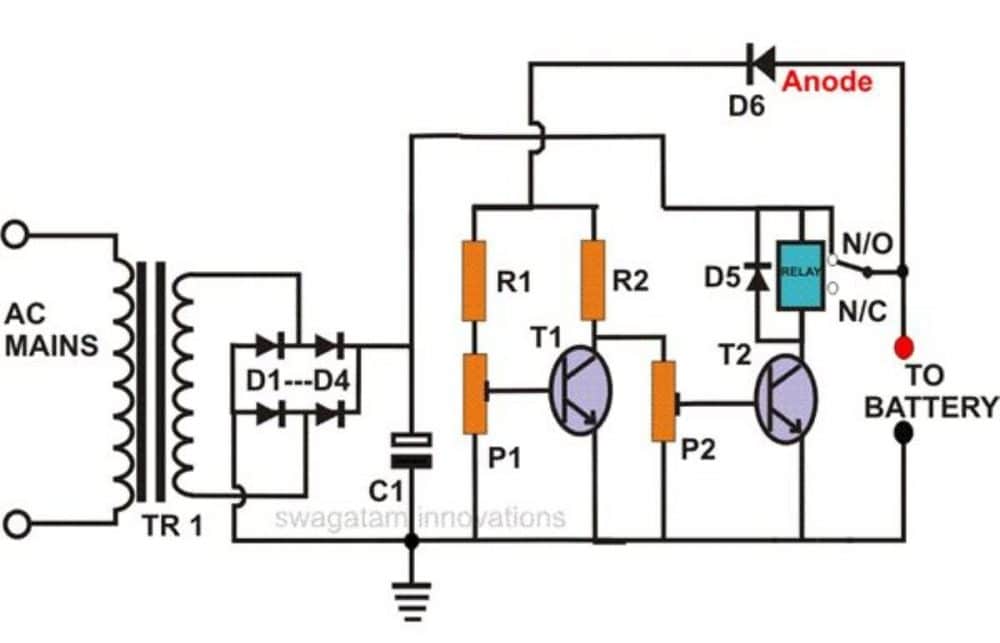
self adjusting battery charger circuit diagram

The following diagram shows the instructions which needs to be followed while setting-up the circuit with the desired cut-of thresholds, using a variable power supply unit:
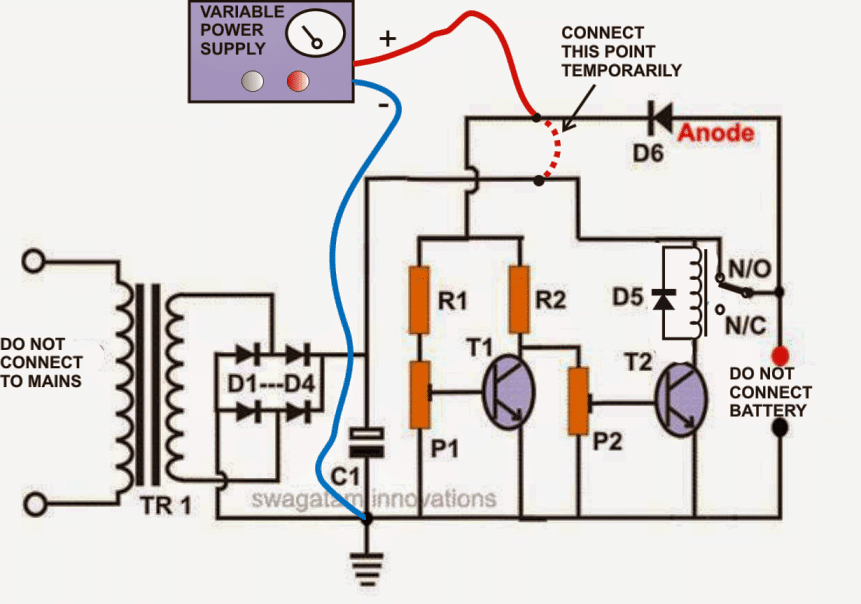
setting up a self adjusting battery charger circuit

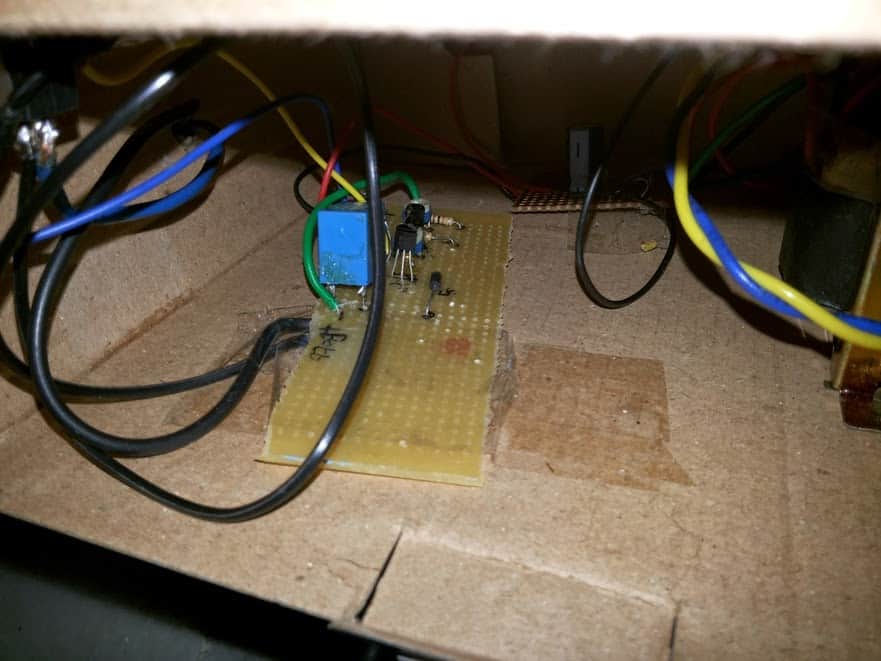
The above self-regulating battery charger circuit was successfully built and tested by Mr. Sai Srinivas, who is just a school kid but nevertheless has an immense interest in the field of electronics.

The following images were sent by him which displays his talent and intense dedication in the field.
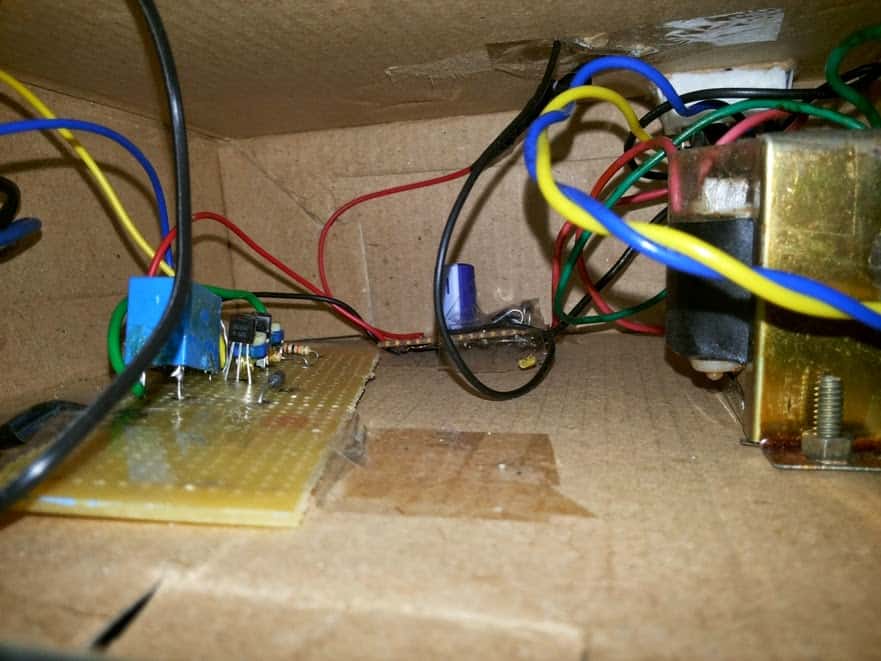
#1 self regulating battery charger prototype images
#2 self regulating battery charger PCB images
#3 self regulating battery charger LED control
#4 self regulating battery charger LED control
#5 self regulating battery charger prototype working

For One Shot Operation

If you want the above circuit to lock itself into a permanent cut off position when the battery is fully charged, then you may modify the design as shown below:
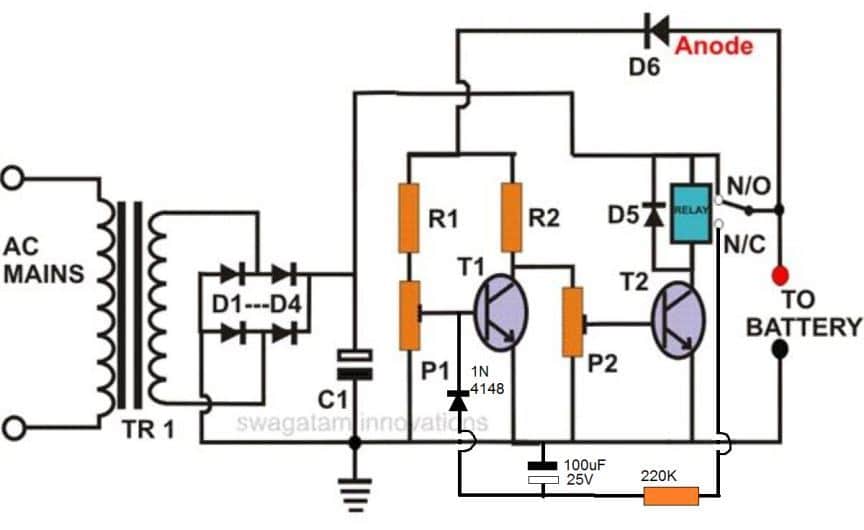
one shot self regulating battery charger with over charge protection circuit diagram

Note: To ensure the relay does not latch itself quickly on power switch ON, always connect the discharged battery first across the shown terminals and then switch ON the input power.

In order to indicate the charging status of the battery, we can add a couple of LEDs to the above design, as shown below.
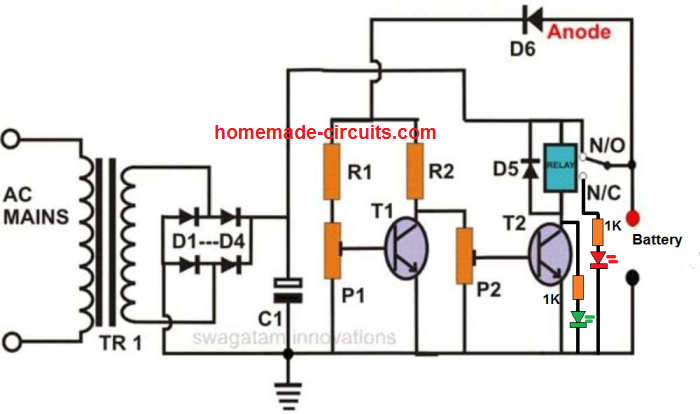
auto adjusting battery charger circuit diagram with LED indicators

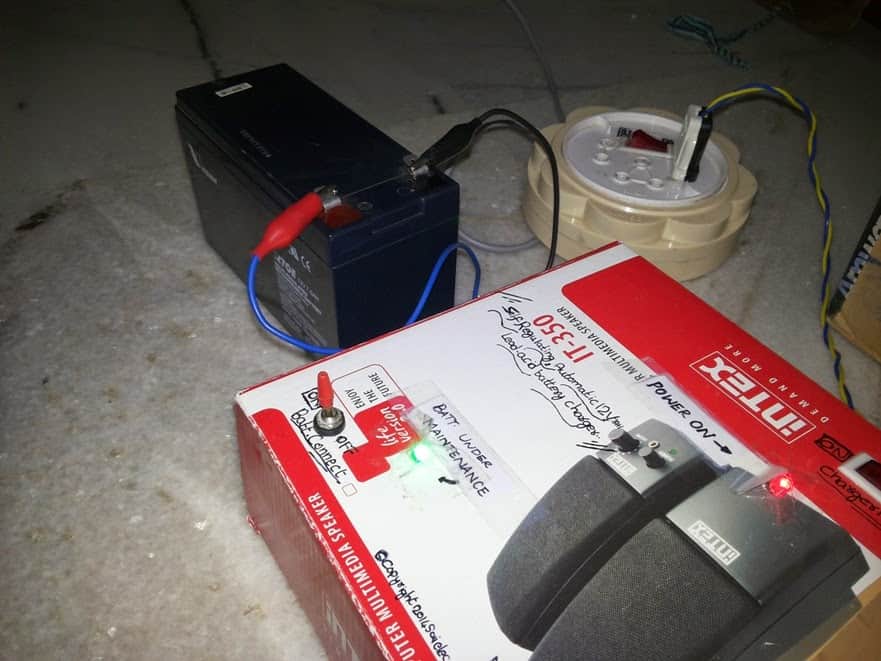
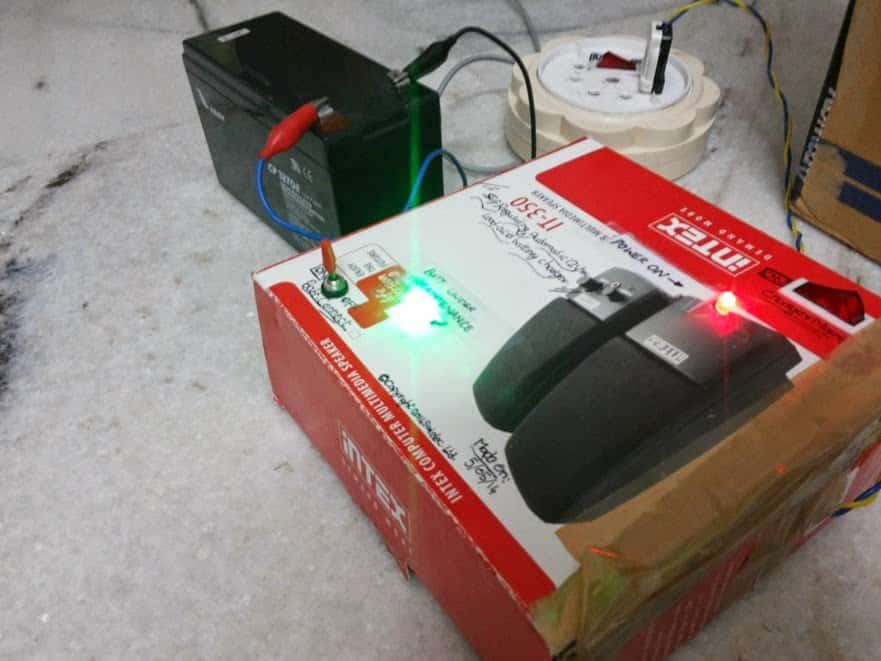
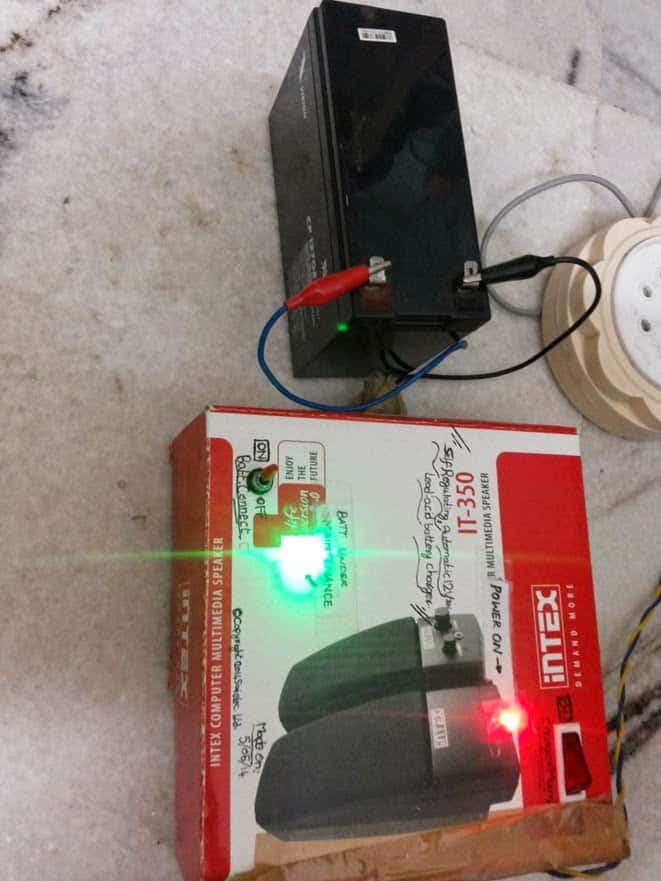
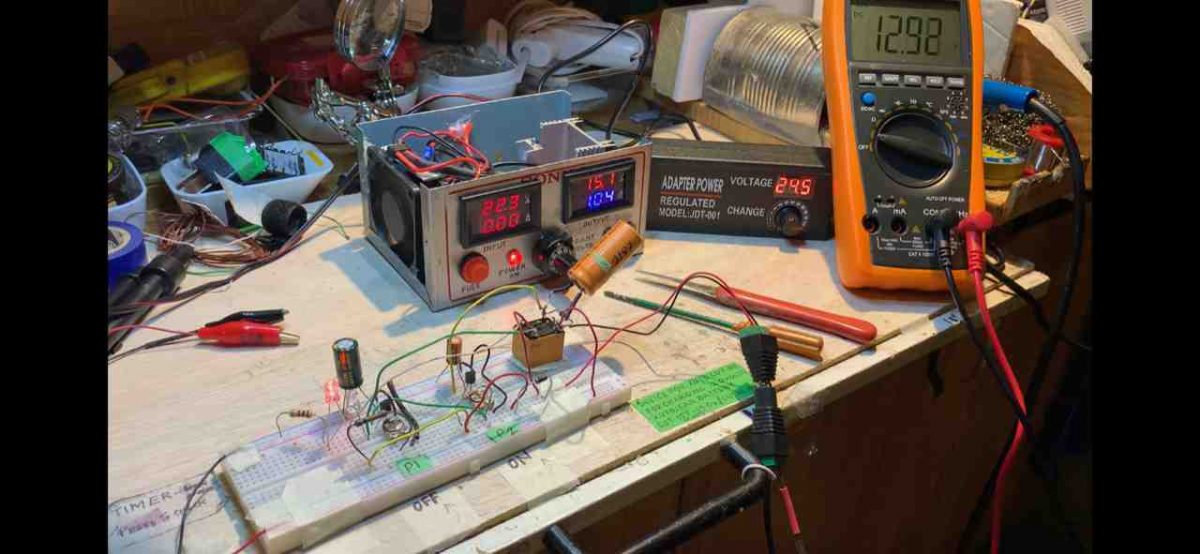
The above circuit was also successfully built and tested by one of the dedicated electronic enthusiasts from this blog. The following pictures verify the results:
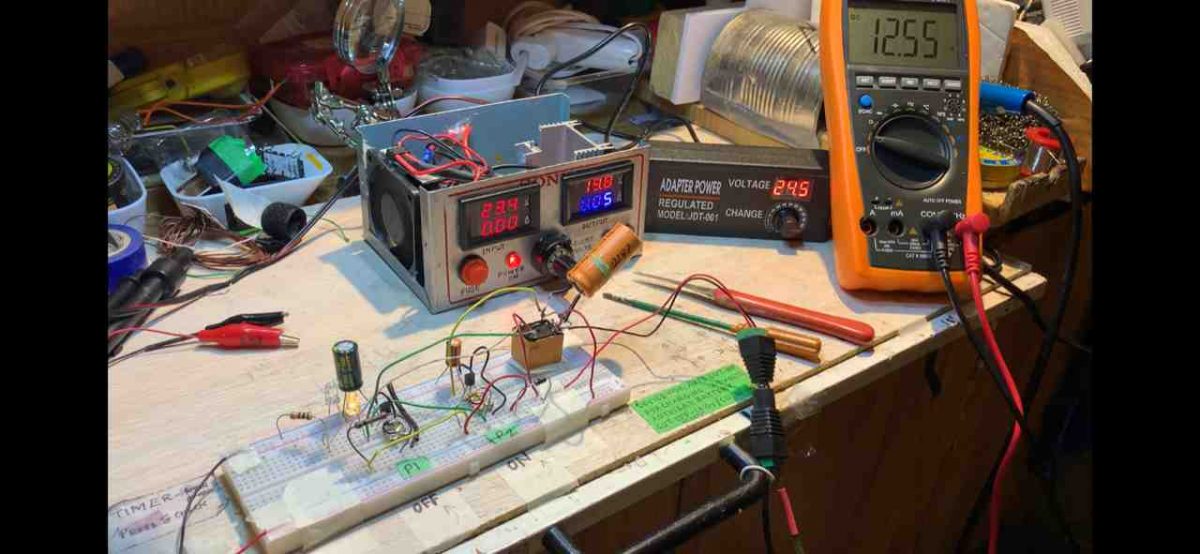
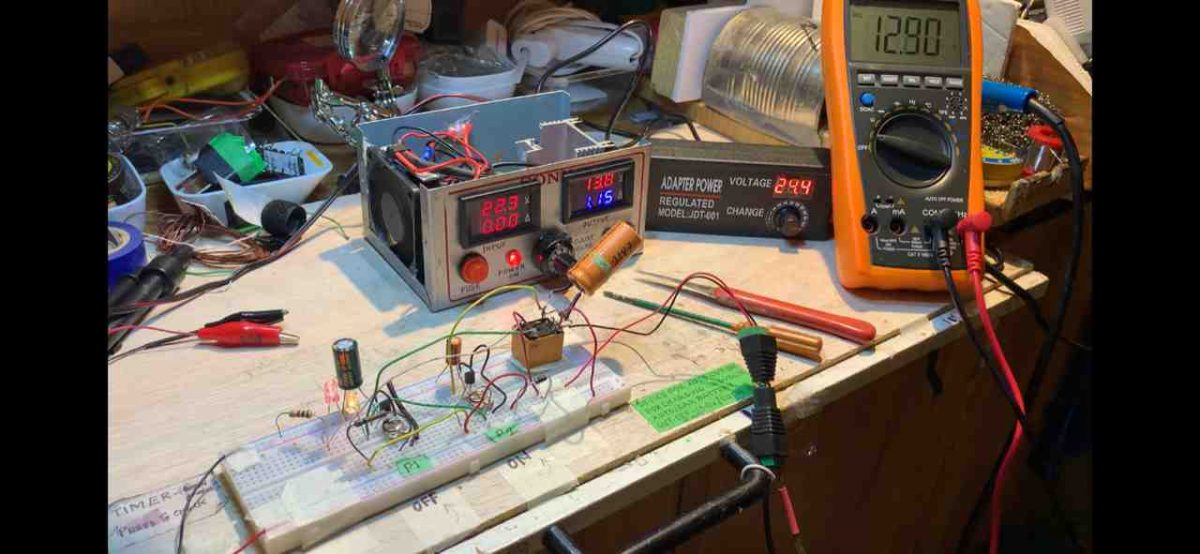
#1 auto adjusting battery charger circuit prototype
Battery is charging, as indicated by the orange LED
#2 auto adjusting battery charger circuit prototype
Battery charger is set to cut off at 12.92V, therefore both the LEDs are ON now, indicating the cut-off threshold has reached
#3 auto adjusting battery charger circuit prototype
Charging is now cut-off, as indicated by the RED LED ON, and Orange LED switched OFF, at the set 12.92 V
#4 auto adjusting battery charger circuit prototype
Image showing the Battery that was used for the charging process

Warning: Make sure to test the preset setting thoroughly before you leave this application unattended. And be sure to use only 14V as the input supply for a 12V battery.

Formulas and Calculations

Full-Charge Cutoff Voltage

The voltage at which charging stops is calculated as:

Vcutoff = VBE(T1) + (P1 / (R1 + P1)) * Vsupply

For example:

Full-charge voltage (target) = 13.8 V

VBE(T1) = 0.7 V (for silicon transistors)

Vsupply = 15 V (after rectification and, filtering)

To achieve a cutoff of 13.8 V you can set the divider network:

13.8 = 0.7 + (P1 / (R1 + P1)) * 15

Rearranging for P1 / (R1 + P1):

P1 / (R1 + P1) = (13.8 - 0.7) / 15 = 13.1 / 15 ≈ 0.873

Choose R1 = 1 kΩ.

Then: P1 = 0.873 * (R1 + P1)

P1 = 0.873 * (1000 + P1)

P1 ≈ 687 / 0.127 = ~6.87 kΩ

Set P1 to approximately 6.8 kΩ.

Reactivation Voltage

The voltage at which charging restarts is calculated as:

Vreactivation = VBE(T2) + (P2 / (R2 + P2)) * Vsupply

For example:

Reactivation voltage = 12.6 V

VBE(T2) = 0.7 V (same assumption as above)

Vsupply = 15 V

To achieve a reactivation voltage of 12.6 V:

12.6 = 0.7 + (P2 / (R2 + P2)) * 15

Rearranging for P2 / (R2 + P2):

P2 / (R2 + P2) = (12.6 - 0.7) / 15 = 11.9 / 15 ≈ 0.793

Choose R2 = 1 kΩ.

Then: P2 = 0.793 * (R2 + P2)

P2 = 0.793 * (1000 + P2)

P2 ≈ 793 / 0.207 = ~3.83 kΩ

Set P2 to approximately 3.9 kΩ.

Relay Activation Current

The current needed to activate the relay is:

Irelay = Vcoil / Rcoil

For example:

Vcoil = 12 V (relay coil voltage)

Rcoil = 400 Ω (typical relay coil resistance)

Irelay = 12 / 400 = 0.03 A (30 mA)

Filter Capacitor Value

The filter capacitor smooths the DC and is calculated as:

C1 = Iload / (2 * f * DeltaV)

For example:

Iload = 1 A (charging current + circuit consumption)

f = 50 Hz (mains frequency)

DeltaV = 2 V (acceptable ripple voltage)

C1 = 1 / (2 * 50 * 2) = 1 / 200 = 0.005 F = 5000 µF

Choose C1 = 4700 µF or 6800 µF... for sufficient filtering.

Hysteresis Voltage

The hysteresis prevents frequent relay switching and is calculated as:

V_hysteresis = V_cutoff - V_reactivation

For example:

V_cutoff = 13.8 V

V_reactivation = 12.6 V

V_hysteresis = 13.8 - 12.6 = 1.2 V

You'll also like:

  • lowbatteryindicatorcircuit 2Low Battery Indicator Circuit Using Two Transistors Only
  • over2Bdischarge2BprotectionArduino based Battery Over Discharge Protection Circuit
  • easiestbatterychargercircuitMake a Battery Charger in 15 Minutes
  • car battery indicator circuit3 LED Battery Level Indicator Circuit

Filed Under: Battery Charger Circuits Tagged With: Battery, Charger, Regulating, Self

About Swagatam

I am an electronics engineer and doing practical hands-on work from more than 15 years now. Building real circuits, testing them and also making PCB layouts by myself. I really love doing all these things like inventing something new, designing electronics and also helping other people like hobby guys who want to make their own cool circuits at home.

And that is the main reason why I started this website homemade-circuits.com, to share different types of circuit ideas..

If you are having any kind of doubt or question related to circuits then just write down your question in the comment box below, I am like always checking, so I guarantee I will reply you for sure!


Previous Post: « Lead Acid Battery Charger Circuits
Next Post: LED Strobe Light Circuit with Chasing, Flashing Effects »

Reader Interactions

Questions & Answers

Total Posts: 263
Newest Oldest
Basil
April 13, 2025 • 1 year ago #172732

is there any way that it can use only one RED LED.
where if it cut off, the RED LED will be off. without switching or cutting from RED LED to Orange?

Reply
SwagatamAdmin
April 14, 2025 • 1 year ago #172932

Remove the two LEDs shown in the last diagram, and connect a single LED in series with the base of the T2 transistor.

Reply
Robert
January 2, 2023 • 4 years ago #138369

Just stumbled upon your very helpful circuit of self regulating battery charger. Please what is the value and type of the diode used in the alternative circuit without relay I mean the one connected to the base of TIP122? Is it a silicon diode? The circuit was last updated on May10, 2021. Thanks for your kindness.

Reply
Robert
January 2, 2023 • 4 years ago #138390

Thanks for responding. I am referring to the reply you sent to Vee on May I 2021 where you posted an alternative circuit diagram using a diode connected to a TIP 122 transistor to replace the relay and the 2nd transistor in the original circuit, thus making it a solid state self regulating auto cut off battery charger. I tried to copy and send it you but didn’t succeed. Thanks again.

Reply
SwagatamAdmin
January 3, 2023 • 4 years ago #138436

OK, understood. However, after a deeper investigation I realized that this circuit had some issues, so I replaced it with a better alternative.
Here’s the link for the new solid state self regulating battery charging circuit, which you can try:

simplest bench power supply

Reply
Robert
January 3, 2023 • 4 years ago #138454

Thank you very much Swagatam. Very happy that people like you are still on this earth. I wish you more knowledge and strength.

Reply
SwagatamAdmin
January 3, 2023 • 4 years ago #138460

Thank you Robert, I am always glad to help!

Reply
SwagatamAdmin
January 2, 2023 • 4 years ago #138380

Hi, thanks, can you please specify which circuit diagram are you referring to?
I cannot see any circuit without a relay…

Reply
Mark
May 28, 2022 • 4 years ago #122078

What is the purpose of C2 ? Will this circuit work without it, and why isn’t shown in the circuit schematic ..?

Reply
SwagatamAdmin
May 28, 2022 • 4 years ago #122080

It is to ensure that the relay does not chatter while switching….it is important to attach this capacitor parallel to the relay coil.

Reply
Mark
May 28, 2022 • 4 years ago #122082

Thank you Swagatam, I thought that’s what D5 was for, but I can assure you I will install that capacitor for good measure ..! Thank you so very much for sharing this circuit, I was trained as a technician and have very limited knowledge of circuit design, thanx again for your help, best regards-Mark

Reply
SwagatamAdmin
May 28, 2022 • 4 years ago #122084

You are welcome Mark, D5 is for shorting out the reverse voltage spikes generated by the relay coil and thus prevent the transistor from getting damaged. For C2 please make sure to use a higher value capacitor such as a 220uF or a 470uF which will ensure smoother switching of the relay. Wish you all the best!

Reply
Mark
May 28, 2022 • 4 years ago #122085

Thanx for the capacitor values and I really appreciate your lightning ⚡️ fast response ..!

Reply
SwagatamAdmin
May 28, 2022 • 4 years ago #122086

I am glad to help!

Reply
Sison.c.S
February 1, 2022 • 5 years ago #111278

greetings…!!!!
Hi dear Swagatham,
Its so inþeresting your circuit.Regarding the first circuit once the max chaeging voltage reach the relay will cut off then when will start the charging automatically again?ie..when 13.8volt set to cutoff then termiñal voltage become low then will it start immediately hence chance for a chattering relay.can we adjust the lower threshold (the point which charging voltage to start again )in any way?expecting your valuable advice.
from Kerala with ❤❤

Reply
SwagatamAdmin
February 2, 2022 • 5 years ago #111308

Thank you Sison, The relay will not chatter actually, rather switch ON/OFF within a span of maybe 4 or 5 seconds.

The switch ON threshold can be perhaps increased by adding a hysteresis to the circuit.

I have tried this through a feedback link, as shown in the second last schematic.

Reply
Kadama
November 4, 2021 • 5 years ago #103798

Owkey sir thanks to reply me!!!
But could u send me your whatsap contact so that u can see easy what I did. Because I used 10K pot which is 103 is real it is exact pot needed? If possible please

Reply
SwagatamAdmin
November 5, 2021 • 5 years ago #103894

Sorry Kadama, providing watsapp number may not be possible. 10k pot will not work correctly, instead you must use a 10K preset, preferably a multiturn type.

Reply
Tony Tuan
August 13, 2021 • 5 years ago #94267

you ask me: how many volts and amps is the input source, how do I connect the capacitor C2 that I don’t understand, can you guide me? I really need this, thank you

Reply
SwagatamAdmin
August 13, 2021 • 5 years ago #94276

Input V and I of the supply will depend on the battery specs. Connect C2 in parallel with the relay coil or D5….positive of the C2 will go on the positive supply line, and negative of C2 will go to the lower terminal of the relay which is connected with the transistor collector

Reply
Tony Tuan
August 13, 2021 • 5 years ago #94287

I drew the circuit of the battery charger to disconnect automatically according to your diagram, can you check it for me, my battery is 12 volts and 7.5 amps, thank you
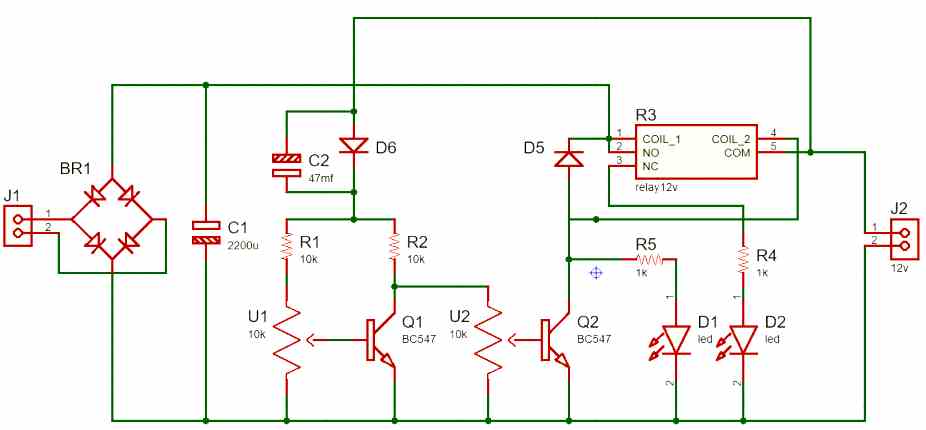
self regulating battery charger proteus result

Reply
SwagatamAdmin
August 14, 2021 • 5 years ago #94387

C2 must be connected parallel to D5, not D6….the relay connections look messy so I cannot comment on that!

Reply
Tony Tuan
August 13, 2021 • 5 years ago #94284

my battery is 12 volt 7.5 amp, so what is the V and I I use, I drew the circuit, I sent it to your email, can you check it for me?

Reply
SwagatamAdmin
August 13, 2021 • 5 years ago #94290

You can use 12V, 1 amp transformer, which will produce around 16 after full bridge rectification. Sorry, I do not communicate through email, if you are having problems with the above schematics please specify about it here.

Reply
Tony Tuan
August 14, 2021 • 5 years ago #94357

hi, I drew a printed circuit using Proteus software based on your schematic, I want to send it to you to check for me but it doesn’t work, my source is 15 volts 7.5 amps, now I want to charge it what to do for my battery, thank you

Reply
SwagatamAdmin
August 14, 2021 • 5 years ago #94372

Hi, I cannot suggest about the Proteus results, but practically the circuit works nicely, I have tested it, and many others have also tested it successfully. However if you want an easier op amp based design I can also provide that

Reply
JOSÉ SILVA
June 12, 2021 • 5 years ago #90919

Na lista de peças fala em C2, mas não é indicado no esquema. Agradeço indicação como ligar.
Obrigado

Reply
SwagatamAdmin
June 12, 2021 • 5 years ago #90926

You must connect C2 across diode D5 or the relay coil. positive of the capacitor will go the cathode of the diode D5, and negative of the capacitor will go to the anode of the diode.

Reply
Vee
May 6, 2021 • 5 years ago #89013

Hi Swagatam
I managed to play around with the above circuit and got the switching – off to on – to about 1 minute 35 secs approximately by adding a 2200 mfd capacitor across the relay and a 1000 mfd across the base emitter of T1 and a 100 mfd across base emitter of T2. So now its not like fast flip flop.
From a discharged level battery it charges up and cuts off at about 13.0 volts and then cycles between 12.55v to about 12.92v.
And I also changed the connections a bit on the Relay. I connected the Common to the positive of the relay and NO to the battery, works fine.
I tried sending you pictures of the project to your email but got a failure reply saying this email does not exist.
Thanks for all your guidance and help, hope you find this ok
Please reply
All the best till the next time
Regards
Vee

Reply
SwagatamAdmin
May 6, 2021 • 5 years ago #89015

Thank you Vee, appreciate your kind feedback

Glad to know the circuit is working OK for you now!

You can send the images to hitman2008 @ live . in

Reply
SwagatamAdmin
May 6, 2021 • 5 years ago #89018

Thank you very much Vee…got all the images, and I will soon publish them all in the above article.

Reply
Vee
May 1, 2021 • 5 years ago #88916

Hi Swagatam
I must thank you immensely for all the help and guidance you have given me and for your precious time and patience.
Im so blessed to have you as a friend in this field of electronics for which I only as a hobbyist have a passion even at this old age,to pass my time in these crazy times bless you,
Thanks for also sending me an alternative circuit which I would try when I am able to get the TIP 122 . Is this also a SELF REGULATING or AUTO CUTOFF
Thanks again Swagatam
All the best to you
Can I send you a picture of my project by email to you, please let me know ok
Vee

Reply
SwagatamAdmin
May 1, 2021 • 5 years ago #88919

Yes definitely….you can send the pics to my email…hitman2008 @ live . in

Reply
SwagatamAdmin
May 1, 2021 • 5 years ago #88918

It is my pleasure Vee, I am always happy to help.

Yes the transistor circuit would work exactly like the relay circuit, but without making any noise, it would silently keep doing the flip flop switching at the battery full charge threshold, and make sure the battery never gets overcharged…

Reply
Vee
May 1, 2021 • 5 years ago #88905

Hi Swagatam
Good news
I managed to get the circuit working finally the only thing is when adjusting the cut off voltage and cut in voltage it keeps switching on and off like a flip flop so fast when I switch off the power supply and back again then its stable but it happens now and then
I added the caps between the base and emitter of the transistors
I know it takes very minute adjustments of the presets
I has to discharge the battery several times down to about 11 volts and try and it recharged quite fast with the power supply I have, recharges at 1.15 to 1.2 amps and goes down to about 250 ma in about half an hour to 13.8 volts
Thanks again for all your help
Regards
Vee

Reply
SwagatamAdmin
May 1, 2021 • 5 years ago #88912

That’s great Vee, at least you could get the circuit to work ON/OFF at the threshold.

If you connect a 1000uF right across the relay that might prevent the relay from self regulating too fast.

Alternatively you can completely get rid of the relay and use only the transistor stages to charge the battery in a solid state manner….here’s the modified diagram for you:

self regulating charger using only transistors

You can replace the T2 with a TIP122

Reply
Suat
September 17, 2021 • 5 years ago #97697

Hello swagatam.
Can you write how to make the settings of the transistor circuit?

Reply
SwagatamAdmin
September 19, 2021 • 5 years ago #97943

Hi Suat, the setting procedure is the same as described in the article.

Reply
Vee
April 30, 2021 • 5 years ago #88895

Hi Swagatam
I know you said the relay connections are exactly as shown in the diagram but I am a little confused with the labelling as you only show NC & NO & not the C
So I want to know if the connection to the battery and the anode side of the diode is on the NO side of the relay and the Common is to the positive side of the relay
Please reply
Thanks
Vee

Reply
SwagatamAdmin
May 1, 2021 • 5 years ago #88903

Hi Vee, the common pole of the relay is connected with the battery positive and the anode of the diode D6, the N/O of the relay is connected with the positive supply line of the circuit. The N/C point is blank.

Reply
Vee
April 30, 2021 • 5 years ago #88894

Hi Swagatam
Thanks for your reply shall do as you have told me
The car battery is 640 Cold cranking amps Reserve is 85 Amps
The Power supply is a variable 4.5 volts to 24 vdc 2amps I also have a 3 Amp one Its set to 14.0 volts
Are these ok or do I have to have higher amps power supply
I tried these power supply with a Auto cutoff circuit of yours using a BC547 or 2N 2222 and the battery charges well intially at about 1.2/1.3A and slowly reduces to about 200 ma and cutoff when the battery is at 13.8 volts , works good
But I am curious to see how this SELF REG. circuit works …… anyway shall try again aa you instructed me
Thanks Swagatam for your help
Vee

Reply
SwagatamAdmin
May 1, 2021 • 5 years ago #88902

Hi Vee, for a 85 Ah battery 2 amp current is too less, and it might take at least 24 hours for the battery to get fully charged.

The above circuit was tested by many of the visitors successfully so the circuit will work although it might require some skillful adjustment of the presets.

Reply
Vee
April 29, 2021 • 5 years ago #88871

Hi Swagatam
I tried the above circuit (self regulating charger) but I still could not get it working
Is the common contact of the relay connected to the anode of the diode and the positive power supply connected to the NO of the relay
When I tried doing the initial settings as per your instruction there is no response on the relay.
I am using a 12 volt cube relay whose coil resistance is 410 ohms
I also tried transistor BC 547 and also 2N 2222 ( pinout is opposite to 547)
Power supply is from my variable bench supply set as per your instructions
Please help
Vee

Reply
SwagatamAdmin
April 30, 2021 • 5 years ago #88886

Hi Vee, yes the relay connections are exactly as shown in the diagram.
You can set up the circuit in the following way.
Keep the slider of both the presets to ground.
Switch ON transformer supply, and then connect a discharged battery to the relay contacts as shown in the diagram.
Now slowly adjust P2 until the relay clicks ON….now the battery will start charging.
Monitor the voltage with a voltmeter until the battery is fully charged.
As soon as the battery is fully charged, slowly adjust the P1 preset until the relay just clicks off.
Your setting up procedure is now complete.
Connect a 100uF capacitor across the base/emitter of both the transistors to stabilize the relay contact operations.
Remember the transformer current must be 10 times less than the lead acid battery Ah rating.

Reply
Vee
March 27, 2021 • 5 years ago #88004

Hi Swagatam
Sorry for troubling you, I was thinking if I could use a bypass transistor like the MJE2955T with the LM 317 to get a higher current output and can i put them on the same heat sink or should they be isolated this 2955 is rated 60V /10A in a TO-220 package will this work for a variable voltage of 1.5v to about 24.0v and 10 amps . I have this transistor.
Appreciate your reply
If I want to send you the circuit which you would definetly know just to be sure I have it right how do i do that .
Thanks
Vee

Reply
SwagatamAdmin
March 27, 2021 • 5 years ago #88012

Hi Vee, It will work but not with 10 amps rather only 5 amps max.

And please, I want you to ask these question under a LM317 or any power supply article, because the above self regulating charger is about battery charging so our discussions are off-topic, right?.

So please ask under a LM317 article or any power supply, I will try my best you solve your queries.

Reply
Vee
March 27, 2021 • 5 years ago #88020

Hi Swagatam
Sorry about being off topic I was not aware how this works I shall pic as you say the related topic and ask my doubts
Sorry about that
Regards
Vee

Reply
SwagatamAdmin
March 27, 2021 • 5 years ago #88023

Hi Vee, you can put your LM317 questions under any of the following articles:

https://www.homemade-circuits.com/?s=LM317

Reply
Ver
March 25, 2021 • 5 years ago #87953

Hi Swagatham
I told you earlier I had made a Variable voltage supply using the LM317 and that is working fine but can only handle 1.0 amp so I tried using an LM338 which I got from China as no store has it locally. Using the same circuit as for the LM 317 I tried replacing it with an LM338 using the same power supply as in the earlier LM317 circuit but there is a bit of flicker and the IC fails and pin 2 & pin3 get shorted out. I put back the LM317 and it worked fine with the same load of about 600 ma I tried again with the LM338 and this to burnt out in seconds
I would like to send you the circuit so you tell me it it’s suitable for both IC ‘s ……. should I send it by email to you please advise
Thanks
Vee

Reply
SwagatamAdmin
March 25, 2021 • 5 years ago #87965

He Vee, that clearly indicates that your LM338s are not good, they may be faulty internally or maybe duplicates.

Instead of using LM338, you can try putting 2 or 3 LM317 in parallel, and mount them over a common heatsink and close to each other. that should effectively work like an LM338 equivalent.

Reply
Vee
March 25, 2021 • 5 years ago #87973

Hi Swagatam
Thanks for your reply, I was considering doing the same as you advised about paralleling 2 or 3 LM 317’s do i have to have any resistors small value at the out puts, can i do 4 of them and if possible can you send me the diagram and this will need a real big heat sink. Do I have to have a minimum load connected to it to avoid over voltage at startup
Thank you very much Swagatam fir all your help if possible you can email me the parallel circuit, I know how it should be but just to make sure Im on the right path and is it ok if I am using a 24 volts /6 amps SMTP adapter or should I use a conventional transformer
Thanks
Vee

Reply
SwagatamAdmin
March 26, 2021 • 5 years ago #87987

Hi Vee, there’s nothing you have to do in the circuit, except connecting the IC pins in parallel, but make sure to connect the ICs over a common heatsink, very close to each other.

Reply
Vee
March 26, 2021 • 5 years ago #87995

Thanks Swagatham
I’ll do as you have advised me
All the best to you
Regards
Vee

Reply
SwagatamAdmin
March 26, 2021 • 5 years ago #87999

You are welcome Vee!

Reply
Collins
March 22, 2021 • 5 years ago #87890

Thanks for your knowledge shared. I will try it. But sir, can it be used on a 12v 200ah inverter battery? Please answer me thanks

Reply
SwagatamAdmin
March 22, 2021 • 5 years ago #87891

Are you referring to the following new post:

Simple SCR Battery Charger Circuit

Reply
Collins
March 23, 2021 • 5 years ago #87898

No sir I’m talking about the Self Regulating Battery Charger Circuit

Reply
SwagatamAdmin
March 23, 2021 • 5 years ago #87902

You can use any battery for charging with the above circuit, regardless of the Ah value, you will only need to suitably upgrade the relay specifications in accordance with the charging current of the battery

Reply
Vee
March 22, 2021 • 5 years ago #87884

Hi Swagatam
Thanks immensely for your prompt reply and help in providing me with some long duration timer circuits, shall try them out and let you know if i did it right
Thanks again
Vee

Reply
SwagatamAdmin
March 22, 2021 • 5 years ago #87887

No problem Vee, I am always happy to help!

Reply
Vee
March 22, 2021 • 5 years ago #87873

Hi Swagatam
I wrote to requesting you to give a circuit for a delayed relay timer of 10 minutes to 2 hours, I have made one from 10 mins to 1 hour with IC 555 but this has I understand a limitation of capacitor of upto 2200 uf
I would appreciate if you could give me a circuit whenever it’s possible by you
Thanks

Reply
SwagatamAdmin
March 22, 2021 • 5 years ago #87883

Hi Vee,

you can try one of these circuits:

https://www.homemade-circuits.com/how-to-make-simple-versatile-timer/

Reply
Vee
March 15, 2021 • 5 years ago #87732

Hi Swagatam
I need some help with converting an ATX to a bench power supply.
I have written to you earlier about your selfregulating battery charger etc and have followed your instructions and got them working and thank you for the same also built a variable power supply and other projects & working good
I am a 70 plus years older hobbist and love doing small electronic projects to keep myself busy and pass my time usefully, I have been interested in electronics for many years and happy to get to know you on the net.
The present problem with the ATX is I have tested it with the power ON switch and the little push switch which turns on the fan and the voltages at the several plugin terminals …….
Orange PG 3.3 v ……. Red + 5.1v ……. Yellow +12.2 v ……. Blue — 12.2v and White — 5.1 v ….. blacks …return/ grd.
When I tried to see if power was really there with a 12 v /10w bulb it did not light up so I added a load resistor 10 ohm 10 watts between the Red and white I guess by mistake then the light came on the resistor got hot and the ATX went off
I should have connected the Red and black to the Resistor I think. Now when I switch on the Power the fan just jiggles and nothing happens . Is there anything I can check or do to get it working or have I made it a paper weight ????
Please reply ……. sorry for the long story
Thanks in advance
This is an old SAMSUNG Model PSCD151404A ATX

Reply
SwagatamAdmin
March 16, 2021 • 5 years ago #87743

Hi Vee, I appreciate your efforts and your interest very much in the field of electronics. I am glad you could build a few of the projects from this website.

For converting your ATX into a bench power supply, you just have to feed the bench power supply output to a regulated bench power supply module. This may be done through a rotary switch for selecting the different ranges of input to the bench power supply module.

Here is a link to the construction of a bench power. The transformer and the bridge section could be eliminated, and replaced by the various outputs from the ATX via a rotary switch:

How to Design a Stabilized Bench Power Supply Circuit

Hope this idea proves useful to you!

Reply
Vee
March 16, 2021 • 5 years ago #87758

Dear Swagatam
Thank you very much for your immediate reply which I appreciate.
I do know I have to either put a rotary switch or have multiple binding posts for the different voltages etc.
If you read the last portion of my message you will see what happened when I was testing it , the ATX Power went dead and when I tried to switch on the power again the cooling fan just jiggles (shakes) but does not run and there are no voltages at any of the leads . So I need to know if any of the IC’s would have shorted out or what should I check or do to get it working again . I checked the 4 amp fuse is ok. So please see if you can guide me where to check etc.
Thanks for your kindness and help, may you be blessed in all your endeavours
Regards
Vee

Reply
SwagatamAdmin
March 17, 2021 • 5 years ago #87775

You ae welcome Vee…
ATX involve SMPS circuits which can be difficult to troubleshoot without a proper test equipment or without practically viewing the circuit.

If you think your ATX is burned then it can be quite difficult to diagnose the fault, unless you are well versed with the working of AC SMPS circuits.

Most probably the MOSFET might have burned, so you can try checking the MOSFET or any big power device associated with the circuit, and see whether it is alright or not…

Reply
Abbas Hamid
February 20, 2021 • 5 years ago #87210

Thank you for putting yuor ccts on net

Reply
SwagatamAdmin
February 20, 2021 • 5 years ago #87216

Thank you for your kind feedback!

Reply
Kesavaraj
February 16, 2021 • 5 years ago #87107

Hai sir..
I try this circuit for my 12v battery.
I adjust preset for low & high voltage threshold.
Relay ON in 11.50V & OFF in 13.90V

Voltage reaches 13.90v the relay turn OFF.
Now the battery voltage will decrease..in 13.20 v the relay is turn ON & charging.. But i set 11.50v to start charging… Pls guide me sir

Reply
SwagatamAdmin
February 17, 2021 • 5 years ago #87117

Hi Kesavaraj,
As mentioned in the title, this is a self regulating battery charger, meaning it will try to restore the charging process as soon as it detects the battery has deviated from the optimum charge level. The single transistor cannot detect or “remember” the preset setting accurately as op amp would do. So what you are seeing is correct, the circuit will keep restoring the charging as soon as it detects a deviation of around 0.5 V or more.

You can try the feedback system as described in the last diagram for increasing the low/high cut off threshold margin. And you can also try using high quality multiturn type preset, which can also help to improve the hysteresis effect

Reply
Kesavaraj
February 17, 2021 • 5 years ago #87138

Thank you sir

Reply
Vee
February 16, 2021 • 5 years ago #87078

Dear Swagatham
In your circuit for ‘ Self regulating battery charger you show that the positive side of the relay is connected to the NO contact of the relay, is this correct or should it be the Common contact as I tried it as per your circuit but it does not work
Kindly reply

Reply
SwagatamAdmin
February 16, 2021 • 5 years ago #87080

Dear Vee, the circuit is correct, the positive charger supply is connected to the N/O of the relay.
The circuit will respond only when a battery is connected.
When you connect a battery, the battery voltage reaches the R1, R2, and goes to the base of T2 through P2. This switches ON the relay, and moves the contact to N/O, which connects the battery with the charging supply from the transformer.

Please check your circuit connections and the preset setting.

Reply
Vee
February 17, 2021 • 5 years ago #87116

Thanks Swagatham for your reply
Connections are as per your circuit which I did on a bread board and I have a 18 volt variable power supply which I used to try doing the setting as per your setup instructions but there is no response neither the LEDs or the relay goes on, I don’t know where I’m wrong …… please advise ……. Thanks

Reply
SwagatamAdmin
February 17, 2021 • 5 years ago #87129

Hello Vee, First of all you must try the circuit on a strip-board by soldering all the parts correctly, a breadboard may cause loose connections and confusions.

For faultfinding, you can check the base to emitter voltages of the two transistors, this will confirm whether the transistors are responding or not.
Or you can connect LEDs in series with the bases of the two transistors which will enable you to see how the transistors are conducting in response the preset adjustments and supply voltage variations.

Reply
Washington Davy Masunga
February 10, 2021 • 6 years ago #86900

Really appreciate your valued input and technical brain engaging circuits. Would you kindly include 24vdc and 48vdc sequential or alternating charging circuits not limited to transistors but including thyristors and mosfets

Reply
SwagatamAdmin
February 10, 2021 • 6 years ago #86910

Thank you very much! You can use the same circuit for 48V or 24V just by upgrading the R1, R2, the relay and the power supply section. If possible I’ll try to update the design soon….

Reply
Levent Erkoşar
January 31, 2021 • 6 years ago #86570

Hello Mr. Swagatam. I have 6 serial connected Lead acid accumulators. Need auto cut-off charger. Can you help me?

Reply
SwagatamAdmin
February 1, 2021 • 6 years ago #86586

Hello Levent, series connected batteries can be charged together, but we cannot guarantee if all the batteries would be charged uniformly, so you will have to connect the charger to individual batteries separately for ensuring that all the equally charged. You can try one of the following designs:

Lead Acid Battery Charger Circuits

Reply
Albert Righteous
January 20, 2021 • 6 years ago #86229

pls, i want to design a power bank of high Mah rating..i want it to charge from normal phone charger and also a solar panel(i currently have one small one, output volt is 6-7volts) but i want it to have auto battery detection….but be as compact as possible
i just dont know how to begin the design..can you pls help??? and with a detailed explanation

Reply
SwagatamAdmin
January 20, 2021 • 6 years ago #86243

you can try the second concept from this article:

https://www.homemade-circuits.com/battery-current-indicator-circuit/

you can feed the solar and phone charger DC inputs both together through separate diodes to the input of the LM338

Reply
youngking
November 9, 2019 • 7 years ago #71906

Sir l’m talking about the diode in this self regulating battery chager in this artcle which other diode is rated 10

Reply
SwagatamAdmin
November 10, 2019 • 7 years ago #71927

youngking, if your battery is 50 Ah then the Bridge rectifier diode will need to be at least 10 amp. LM358 cannot be used for those mentioned ICs,

Reply
Evans
July 4, 2020 • 6 years ago #80116

Sir I want to design this charger circuit for a 24v battery,any changes to the circuit??

Reply
SwagatamAdmin
July 4, 2020 • 6 years ago #80121

No change in parts except the relay and the transformer which must be 24 v rated.

Reply
youngking
November 1, 2019 • 7 years ago #71638

good day sir , pls can u named the diode that is rated 10amps. also can one use lm 358 in place of lm 350, 396, 338 then other ones that can handle 10amps current. waiting for ur response

Reply
SwagatamAdmin
November 1, 2019 • 7 years ago #71647

Youngking, please post the question under the article that you are referring to, so that I can check to the diagram quickly

Reply
Scotlin Askew
October 26, 2019 • 7 years ago #71413

Do you have a schematic for a self charging Bluetooth speaker type design? I am taking a electric class and the teacher says to have a project in mind, I want speaker which charges itself when it’s low

Reply
SwagatamAdmin
October 26, 2019 • 7 years ago #71414

The charging can happen from a source, such as from a AC mains input. Do you mean an automatic charging?

Reply
Scotlin Askew
October 27, 2019 • 7 years ago #71453

Yes like a self contained charge. I don’t want to have to plug my speaker in Everytime it dies, I want it to keep it self charged when it hits a level it charges back up to full. I think that’s the one you sent me.how would I add a blue tooth speaker into the mix

Reply
SwagatamAdmin
October 28, 2019 • 7 years ago #71465

In that case you can try the second concept from the following article:

https://www.homemade-circuits.com/how-to-make-current-controlled-12-volt/

Ignore the trasformer and the meter, use only the transistor resistor, zener diode for the operations. Just make sure the output across the emitter and ground of the transistor is 0.7V higher than the full charge level of the battery. Set this without any battery connected. This may be set by tweaking the zener diode value appropriately.

Reply
youngking
August 13, 2019 • 7 years ago #69204

sir thank you for your hard effort, God bless you

Reply
SwagatamAdmin
August 13, 2019 • 7 years ago #69209

You are welcome!

Reply
youngking
August 11, 2019 • 7 years ago #69182

hello sir ,there is question I ask u concerning this self regulating battery charger which how to involve two led one to indicate battery charging and another led ted to indicate when battery is fully charger. and here was your reply.” Connect one LED from N/C to ground, and other from N/O to ground, via 1K individual resistors now my first query is (1..) is it to add the 1k resistor to the anode before connecting it to N/C. 2. if I’m using 75ah battery what modification will I make in this circuit. 3. u said that when charging lead acid battery that the current and the transformer should be 1/10th of the battery. pls can u explain this with an example. am waiting for your responds.

Reply
SwagatamAdmin
August 12, 2019 • 7 years ago #69190

Hello youngking, I have updated the LED diagram at the end of the post, you can check it out. For 75 Ah, just make sure the relay contacts can handle upto 15 amps or more, and make sure the transformer current is not more than 10 amps.

For knowing the charging current details, please refer to the following article:

https://www.homemade-circuits.com/high-current-10-to-20-amp-automatic/

Reply
View Older Comments

Need Help? Please Leave a Comment! We value your input—Kindly keep it relevant to the above topic! Cancel reply

Your email address will not be published. Required fields are marked *

Primary Sidebar


Categories

  • Arduino Projects (95)
  • Audio and Amplifier Projects (134)
  • Automation Projects (18)
  • Automobile Electronics (104)
  • Battery Charger Circuits (90)
  • Datasheets and Components (109)
  • Electronics Theory (150)
  • Energy from Magnets and Earth (41)
  • Games and Sports Projects (11)
  • Grid and 3-Phase (20)
  • Health related Projects (27)
  • Home Electrical Circuits (13)
  • Indicator Circuits (16)
  • Inverter Circuits (100)
  • Lamps and Lights (163)
  • Meters and Testers (72)
  • Mini Projects (28)
  • Motor Controller (68)
  • Oscillator Circuits (30)
  • Pets and Pests (15)
  • Power Supply Circuits (91)
  • Remote Control Circuits (50)
  • Security and Alarm (65)
  • Sensors and Detectors (107)
  • SMPS and Converters (46)
  • Solar Controller Circuits (62)
  • Temperature Controllers (44)
  • Timer and Delay Relay (50)
  • Voltage Control and Protection (44)
  • Water Controller (37)
  • Wireless Circuits (31)


Circuit Simulator

circuit simulator image


Subscribe to get New Circuits in your Email


Other Links

  • Privacy Policy
  • Cookie Policy
  • Disclaimer
  • Copyright
  • Videos
  • Sitemap

People also Search

555 Circuits | 741 Circuits | LM324 Circuits | LM338 Circuits | 4017 Circuits | Ultrasonic Projects | SMPS Projects | Christmas Projects | MOSFETs | Radio Circuits | Laser Circuits | PIR Projects |


Recent Comments

  • Swagatam on Simple Walkie Talkie Circuit
  • Swagatam on Electronic Circuit Projects, Tutorials, and Practical Engineering Solutions
  • Swagatam on How to Replace a Transistor (BJT) with a MOSFET
  • SA on How to Replace a Transistor (BJT) with a MOSFET
  • Adil on Simple Walkie Talkie Circuit

Social Profiles

  • Twitter
  • YouTube
  • Instagram
  • Pinterest
  • My Facebook-Page
  • Stack Exchange
  • Linkedin

© 2026 · Swagatam Innovations